
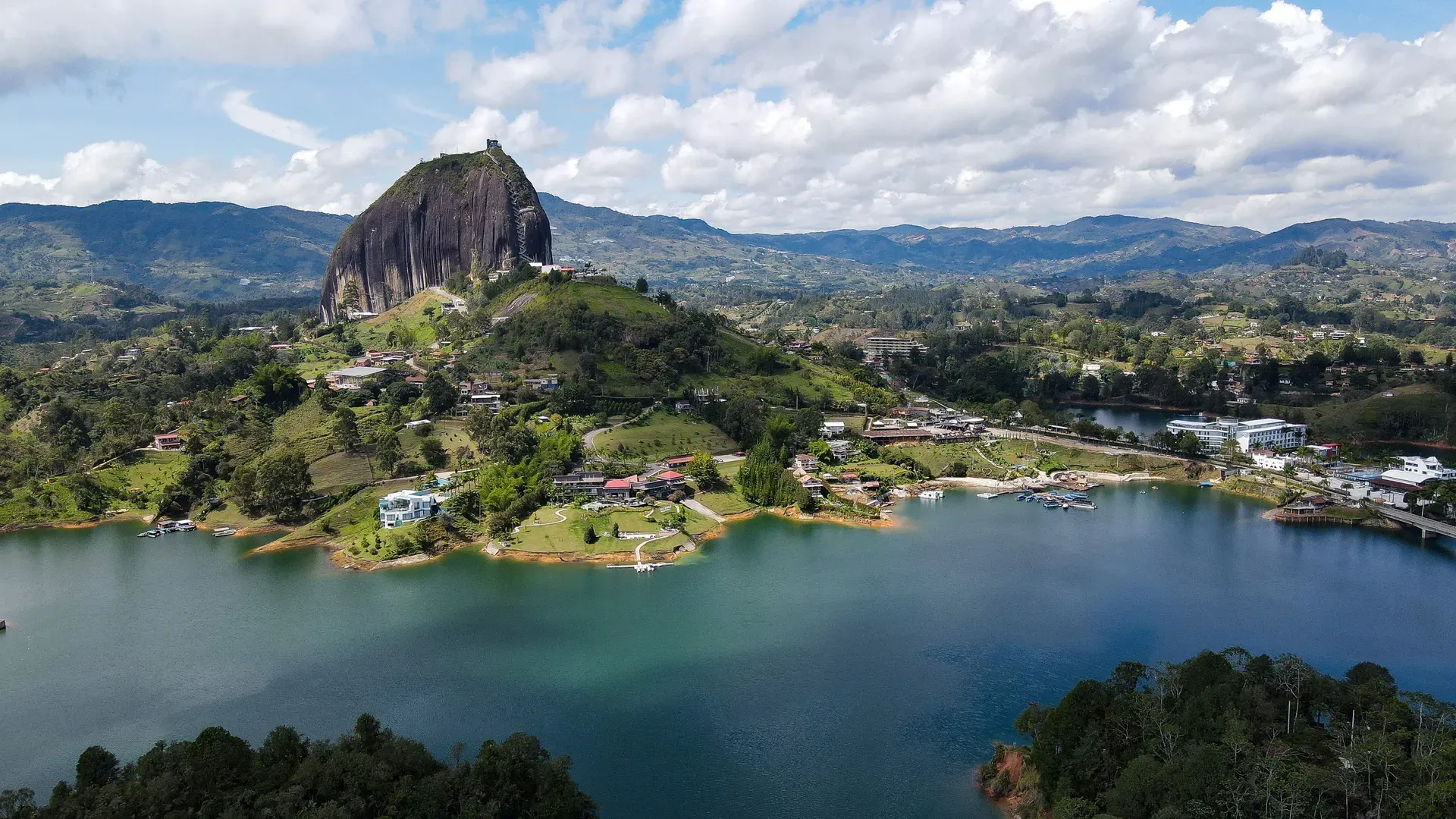
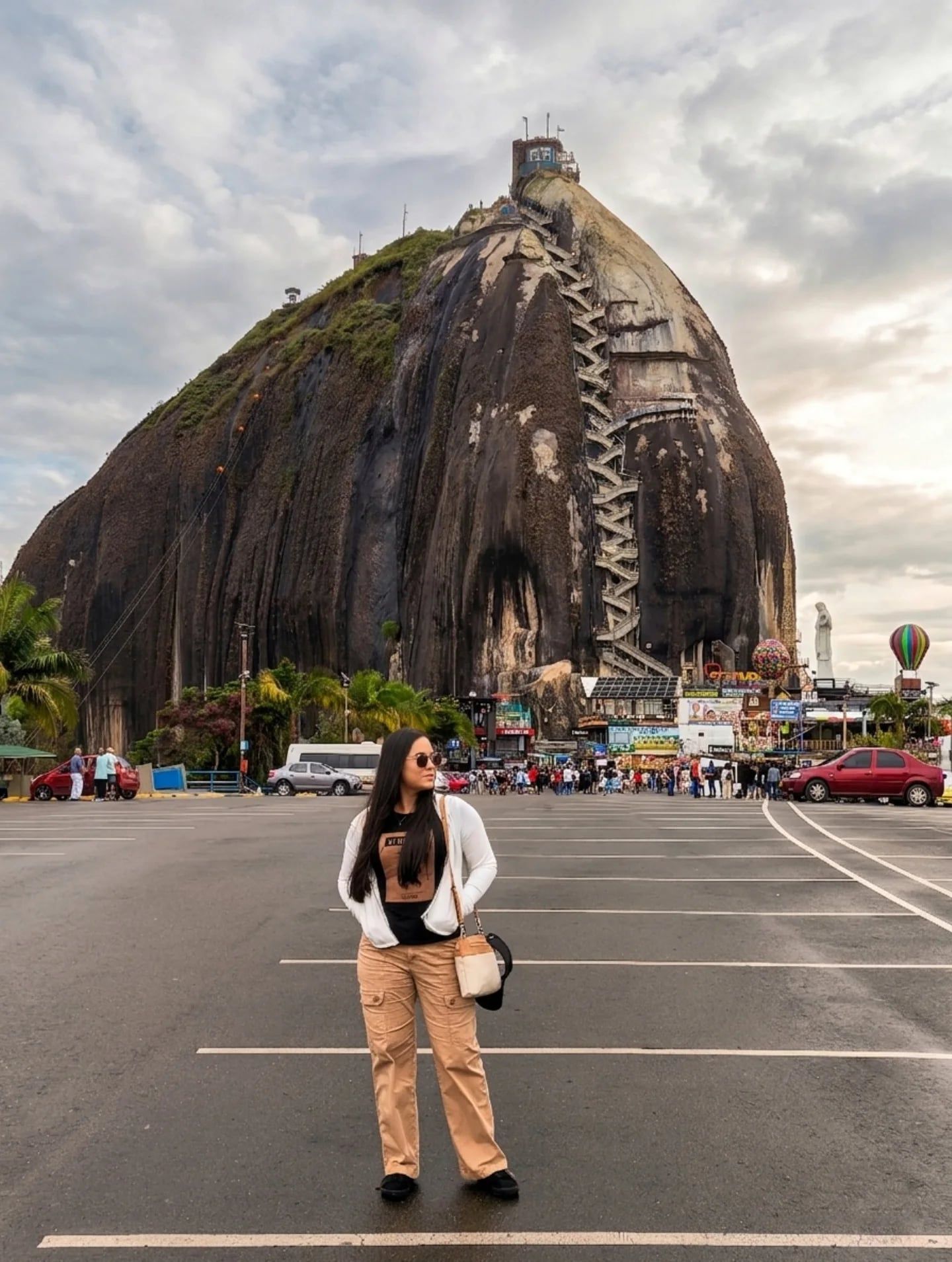
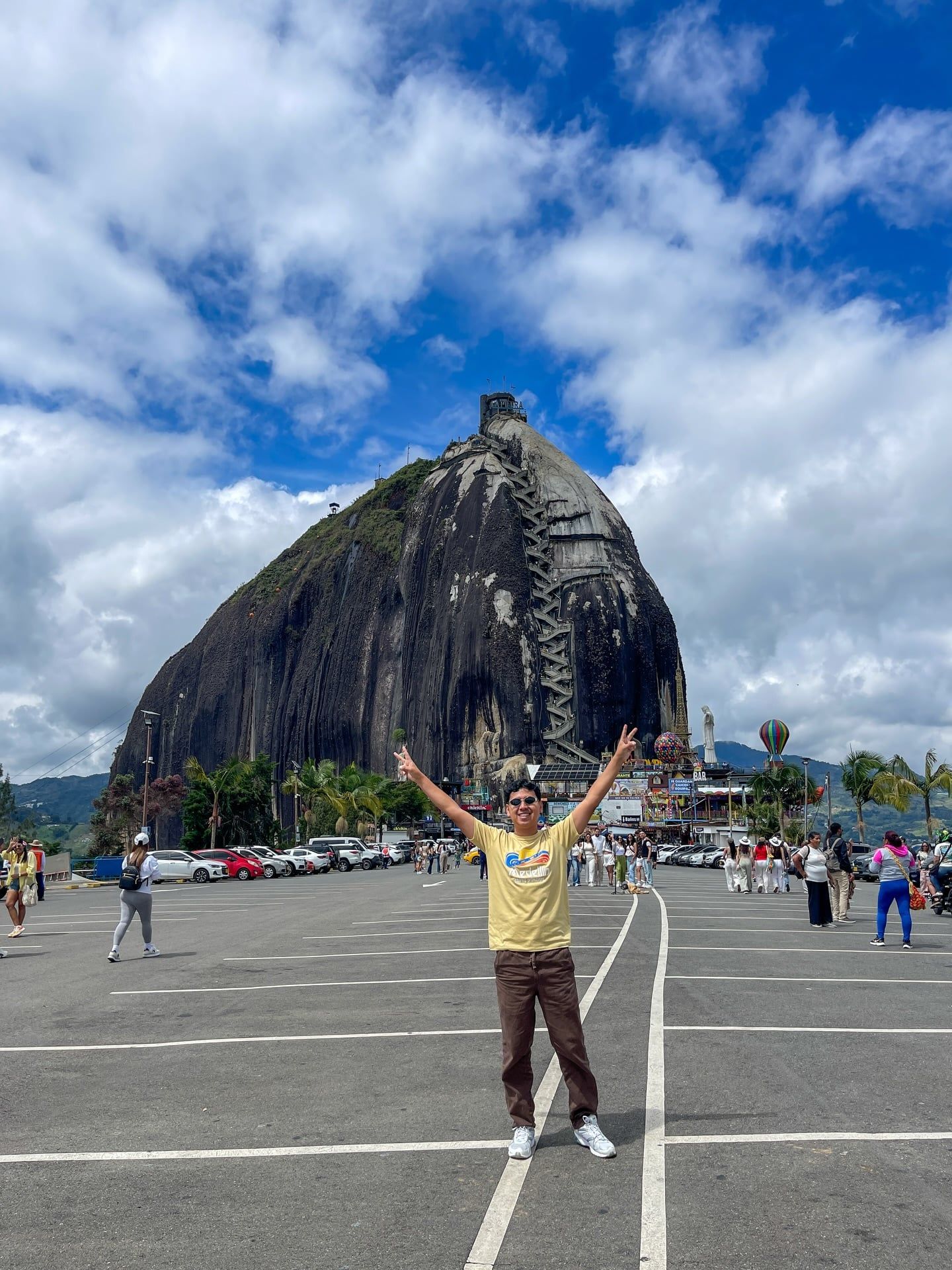
This 65-million-year-old granite monolith rises 220 meters above the rolling Antioquia landscape. Visitors who climb the steep 740-step concrete staircase are rewarded with 360-degree views of a massive 2,262-hectare artificial reservoir.
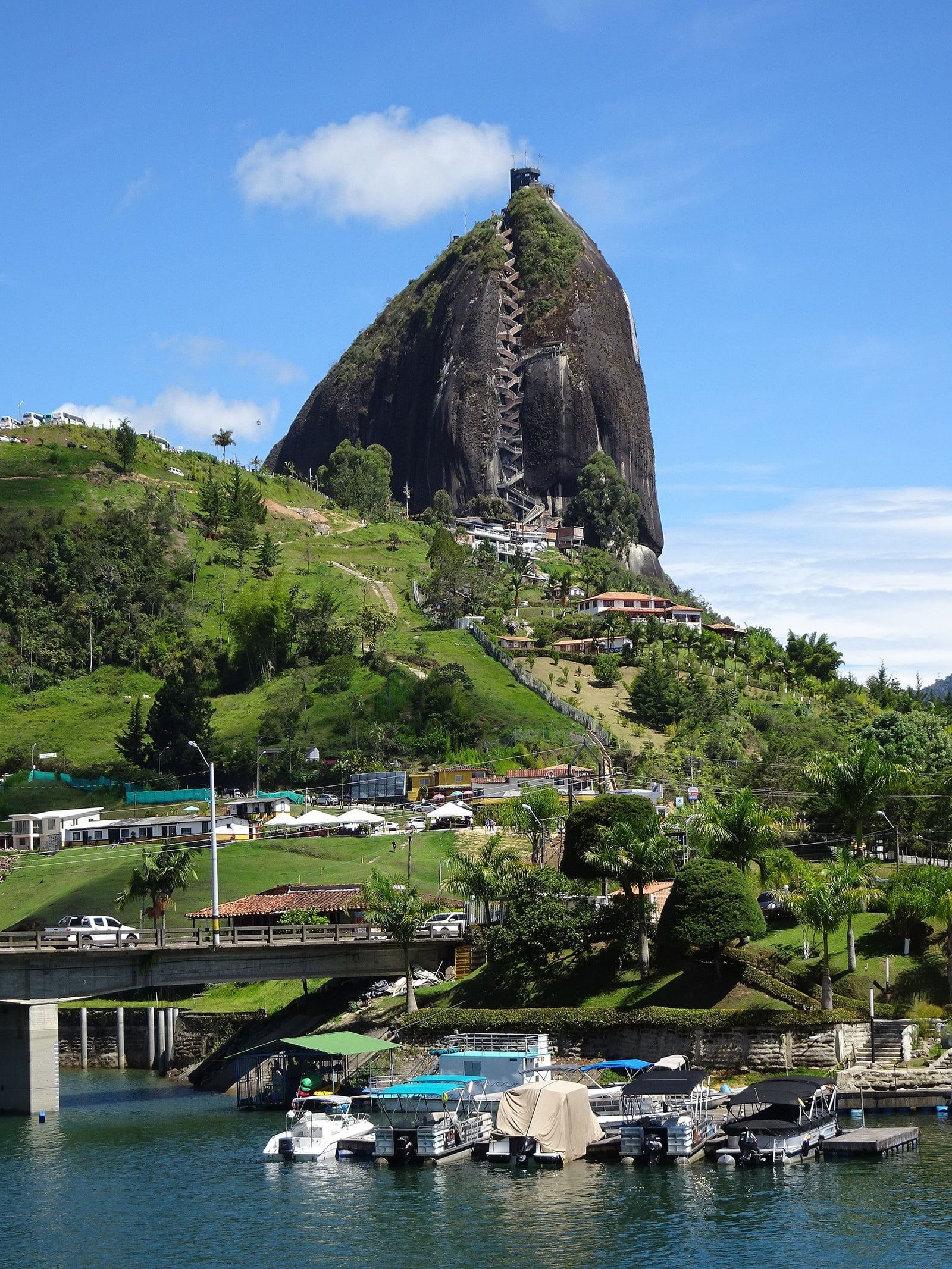
Find Guided ToursLa Piedra del Peñol, also known as the Rock of Guatapé, is a 220-meter-high granite monolith located in eastern Antioquia, Colombia. Standing at an elevation of 2,135 meters above sea level, the rock measures 285 meters in length and 110 meters in width. It extends between one kilometer and 2,500 meters underground, rising prominently above a 2,262-hectare artificial reservoir created in the 1970s for hydroelectric power generation.
Geologists estimate this massive inselberg is between 65 million and 80 million years old. It formed deep within the Earth as part of the 7,800-square-kilometer Antioquia Batholith, which was pushed upward by tectonic plate movements. Over millions of years, the surrounding land eroded away, leaving this highly resistant granite structure exposed to the elements.
Long before modern tourism, the ancient indigenous Tahamí people considered the rock a sacred site of worship. They called it 'mojarrá' or 'mujará,' meaning 'stone,' and believed the monolith possessed a special spiritual energy. Recognizing its cultural importance, the Colombian government officially declared it a National Monument in the 1940s.
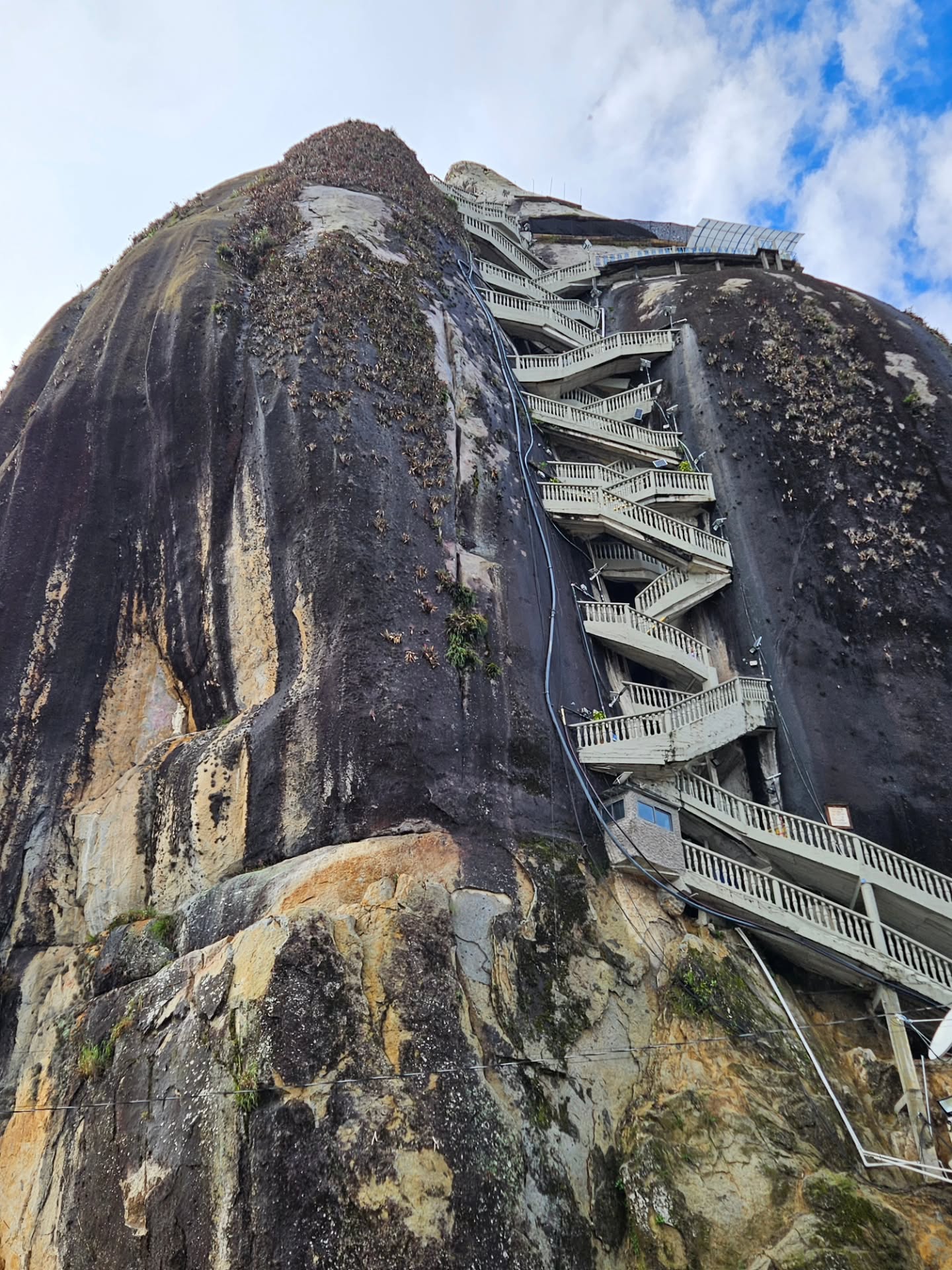
The monolith remained unclimbed until July 16, 1954, when Luis Eduardo Villegas López, Pedro Nel Ramírez, and Ramón Díaz completed a challenging five-day ascent by wedging sticks into a natural crack. Villegas subsequently purchased the rock from local farmers who deemed the land useless for agriculture, constructed the initial staircases, and established the current tourism operation. Today, visitors ascend a 740-step concrete staircase built directly into that same natural fissure to reach the summit.
The landmark sits between the municipalities of El Peñol and Guatapé, sparking a persistent territorial dispute. In 1987, the Guatapé town council attempted to assert ownership by painting their town's name on the northern face. Authorities halted the project after only completing the letter 'G' and part of a 'U', leaving a famous unfinished mark on the stone.

Discover the full history and cultural significance on our About page.
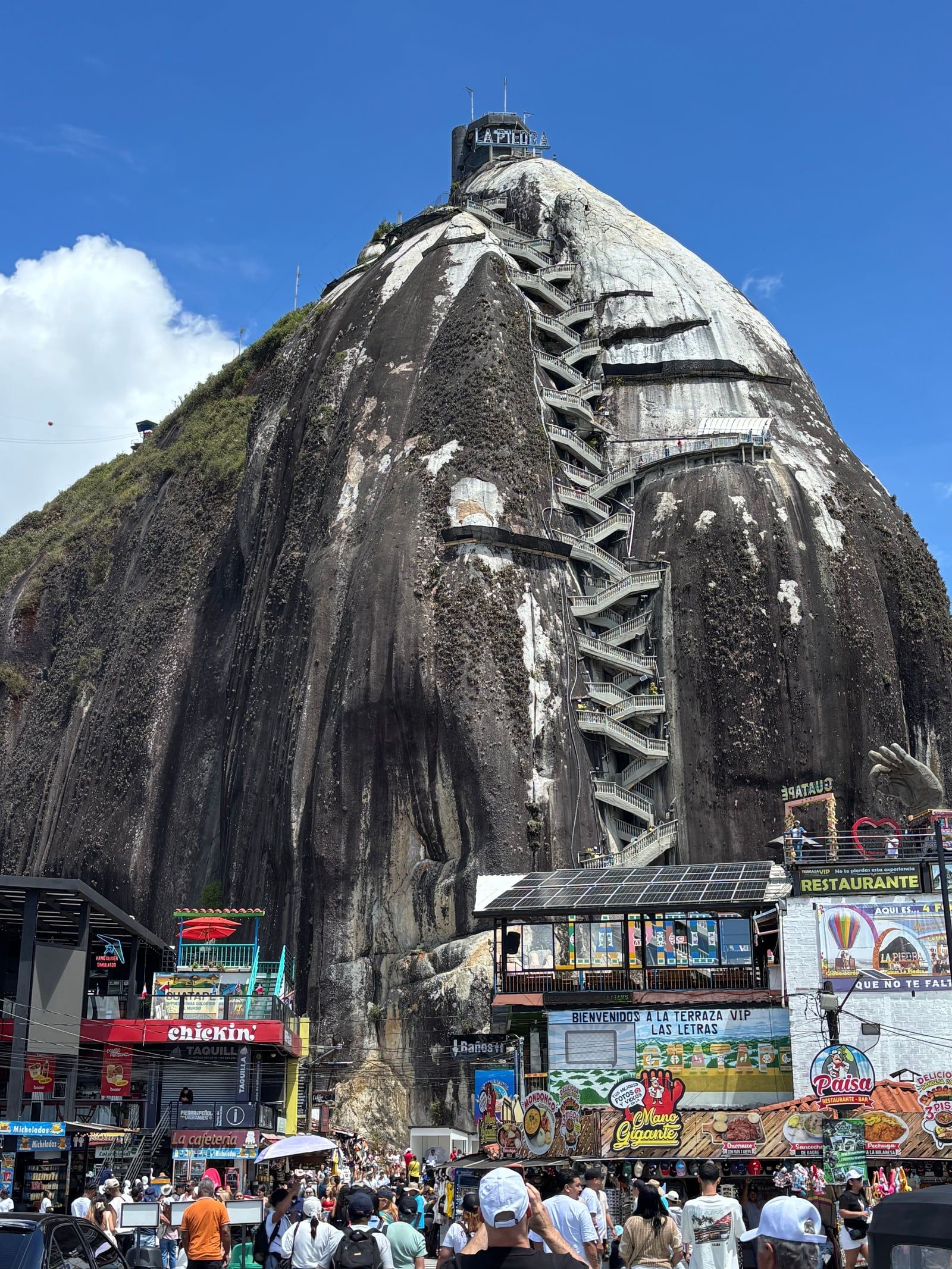
Ascend a zigzagging concrete staircase built directly into a natural crack of this 65-million-year-old granite monolith. You can track your progress using the numbered steps along the route. The physical challenge takes about 15 to 30 minutes, featuring several scenic viewpoints to catch your breath.
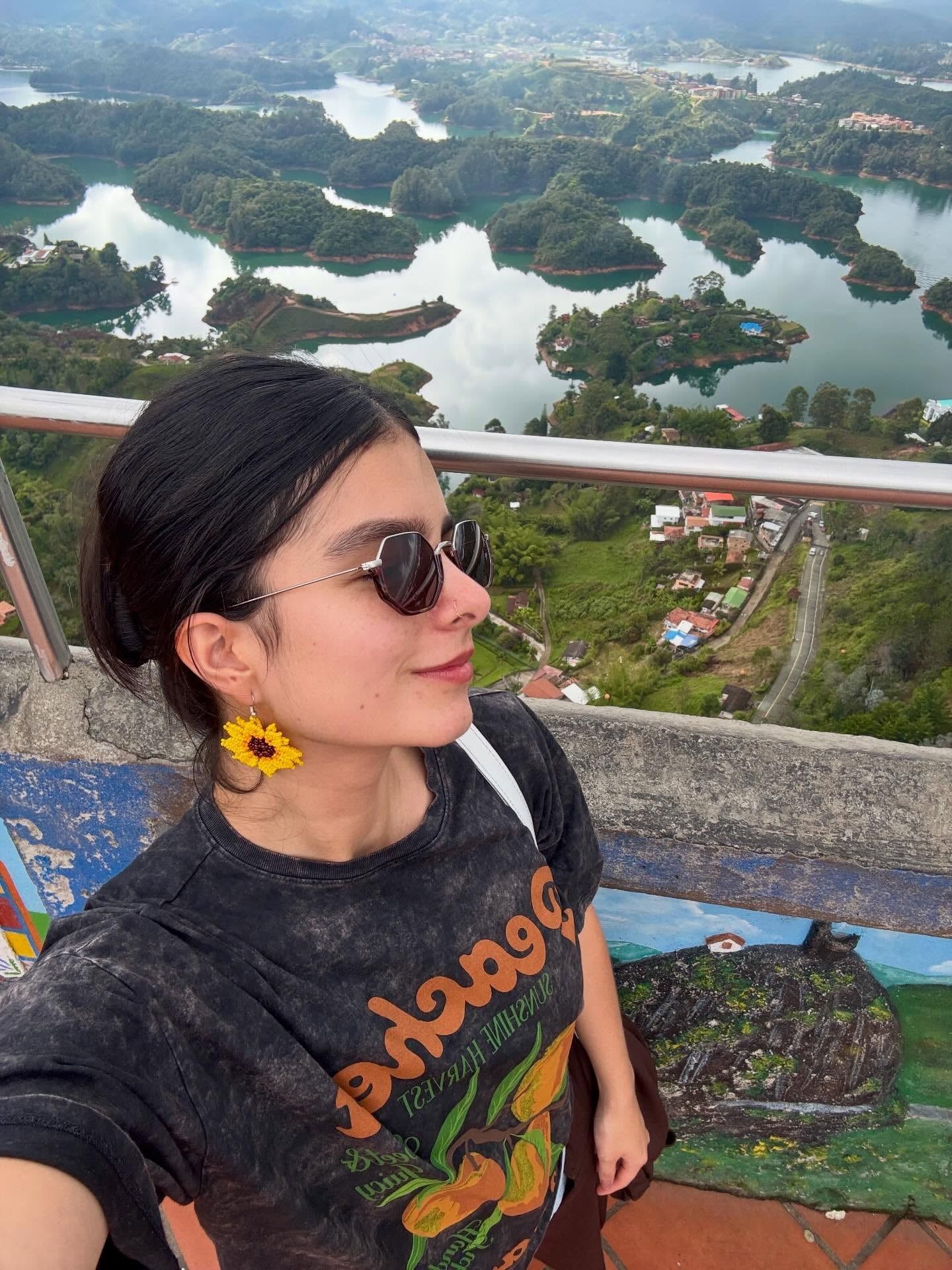
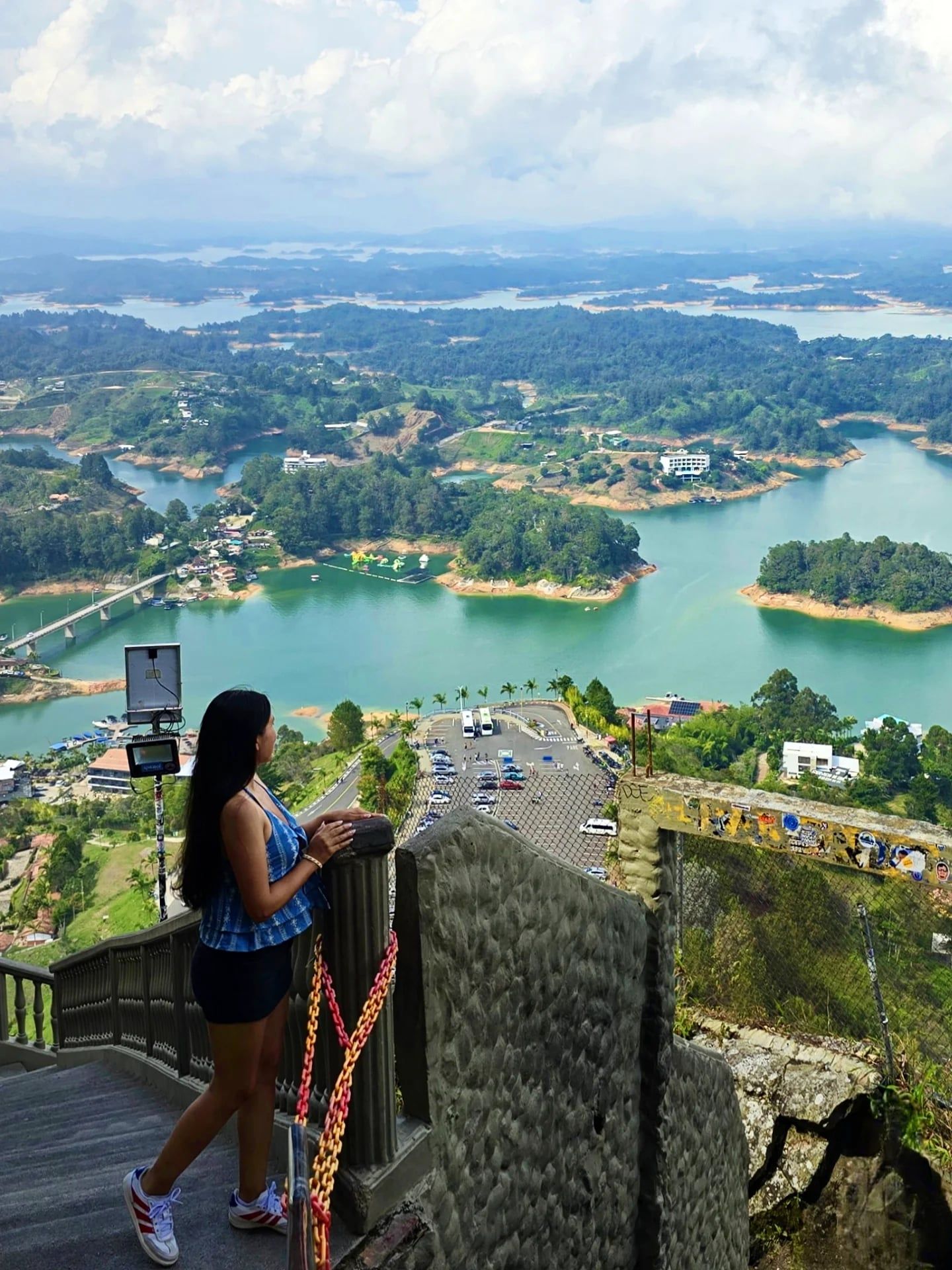
Reaching the viewing tower at the 2,135-meter summit provides 360-degree panoramic sights. You can look down over the 2,262-hectare artificial lake created for hydroelectric power in the 1970s. The vast, winding reservoir meanders through green hills and tropical rainforests stretching for miles in every direction.
Look at the northern face of the 220-meter-tall rock to see massive white painted letters spelling 'G' and part of a 'U'. This unfinished project is a physical remnant of a 1987 territorial dispute, halted by authorities when Guatapé attempted to paint its name to claim ownership.
Stand at the base of the monolith to admire colorful murals detailing its ancient indigenous Tahamí history. Once you finish the challenging climb, you can browse local artisan souvenirs at the summit commercial area and reward your physical effort with a cold drink or a creamy mango paleta.
Hand-picked tours with free cancellation and verified reviews
 Free Cancellation
  Free Cancellation
  Free Cancellation
  Free Cancellation 11h
  Free Cancellation
  Free Cancellation 11h
  Free Cancellation
  Free Cancellation 8h
 The best time to visit Piedra del Peñol is early morning at 8:00 AM on weekdays (Tuesday through Thursday) during the drier seasons. Avoid peak vacation periods like December, January, and Easter Week, when the 740-step staircase experiences extreme congestion.
This period includes Easter Week (Semana Santa), identified as one of the worst times to visit. The site experiences extreme congestion and a chaotic atmosphere during this major holiday.
Mid-week visits from Tuesday through Thursday are highly recommended. Arriving at 8:00 AM helps visitors avoid the large tour buses from Medellín that begin congesting the site around 9:45 AM.
Traveling during non-holiday periods allows for a peaceful experience. Visitors should aim for drier days to ensure safe climbing conditions on the steep stairs and clear 360-degree panoramic views.
December and January are peak vacation months and rank among the worst times to visit. Expect extreme traffic delays from Medellín and gridlock on the narrow concrete staircases.
Piedra del Peñol is open to the public daily from 8:00 AM to 6:00 PM. Certain administrative and ticketing services may operate on a slightly reduced schedule, closing at 5:00 PM.
| Category | Price |
|---|---|
| Standard Entry (On-site) | COP 20,000 - COP 25,000 (approx. USD 5) |
| Children and Seniors (On-site) | COP 15,000 |
| Skip-the-line Ticket (Online Advance) | COP 59,000 (approx. USD 18) |
On-site entrance fees are payable strictly in cash using Colombian Pesos (COP). The ticket booth at the base does not accept credit cards or foreign currency. Advance booking is not required for general entry, but skip-the-line tickets can optionally be booked online.
For complete schedules and ticket prices, visit our Hours & Fees page.
Reaching the monolith is straightforward from both Medellín and the nearby town of Guatapé. Travelers can choose between public buses, private rides, or local motorized transport depending on their starting location.
📍 Between the municipalities of El Peñol and Guatapé, Antioquia, Colombia
Buses depart every 30 minutes between 06:00 and 18:00 from the Terminal de Transporte del Norte in Medellín. You can find the Sotrasanvicente or Sotrapeñol operators at counters 9 and 14, which are accessible via the Caribe metro station. When boarding, explicitly ask the driver to drop you off at the entrance to the Piedra del Peñol. This 80-kilometer route takes approximately two hours.
Hiring an Uber from Medellín is a highly convenient alternative for those wanting a direct route. This option drops passengers off right at the foot of the monolith, bypassing the need to navigate complex Colombian roads independently. The 80-kilometer drive depends heavily on traffic conditions but generally takes around 90 minutes. It provides a comfortable, private transit method straight to the site.
Small, motorized tricycles known as tuk-tuks are readily available throughout the town square of Guatapé. These colorful vehicles provide an open-air transit option for the short 4-kilometer distance to the site. The ride takes about 10 to 15 minutes and drops visitors right at the pedestrian entrance of the rock. It is a highly practical choice for those already staying in the local area.
For detailed transport options and routes, visit our Directions page.
Plan your visit for a Tuesday, Wednesday, or Thursday and arrive exactly at the 8:00 AM opening time. Large tour buses from Medellín begin arriving around 9:45 AM, quickly congesting the narrow staircases. Avoiding these peak hours makes taking photos at the summit much easier.
You must bring physical Colombian Pesos to pay the on-site entrance fee of COP 20,000 to COP 25,000. The ticket booth does not accept credit cards or foreign currency. Guatapé has only one reliable ATM, which frequently runs out of cash, so withdraw money before arriving.
Ensure you wear sturdy closed-toe tennis shoes or sneakers with excellent grip. The 740 concrete steps are steep and narrow in the descent section. They can become highly slippery during sudden afternoon rain showers, making loose footwear like flip-flops a serious safety hazard.
The entire 740-step staircase is fully exposed to the sun with absolutely no overhead cover. Apply high-SPF sunscreen before starting the physical exertion of the climb. You should also wear a protective hat and sunglasses to effectively shield yourself from the intense equatorial UV rays.
Keep your hands completely free during the steep ascent by carrying a small backpack or purse. Having free hands allows you to safely grip the metal handrails and easily access your water bottle. Note that heavy backpacks are strictly prohibited on the staircase.
The summit sits at an elevation of 2,135 meters above sea level, making the 740-step ascent highly strenuous. Pace yourself to avoid exhaustion and utilize the designated rest areas, including the Virgin Mary shrine. If needed, two medical assistance points staffed by paramedics are located along the path.
This colorful colonial village is famous for its zócalos, which are hand-painted bas-reliefs decorating the lower walls of houses. Walking through streets like Calle del Recuerdo and Plazoleta de los Zócalos connects visitors directly to local culture.
Created in the 1970s for hydroelectric power, this massive 2,262-hectare artificial lake was formed by flooding the old town of El Peñol. Visitors can take boat cruises, rent jet boats, or go wakeboarding across the water.
This themed park features a detailed reconstruction of the original town of El Peñol, which was entirely submerged during the reservoir's creation. The site serves as a historical monument, allowing visitors to understand the area's dramatic past.
Read what travelers share about their experience visiting Piedra del Peñol — from practical tips to personal highlights.
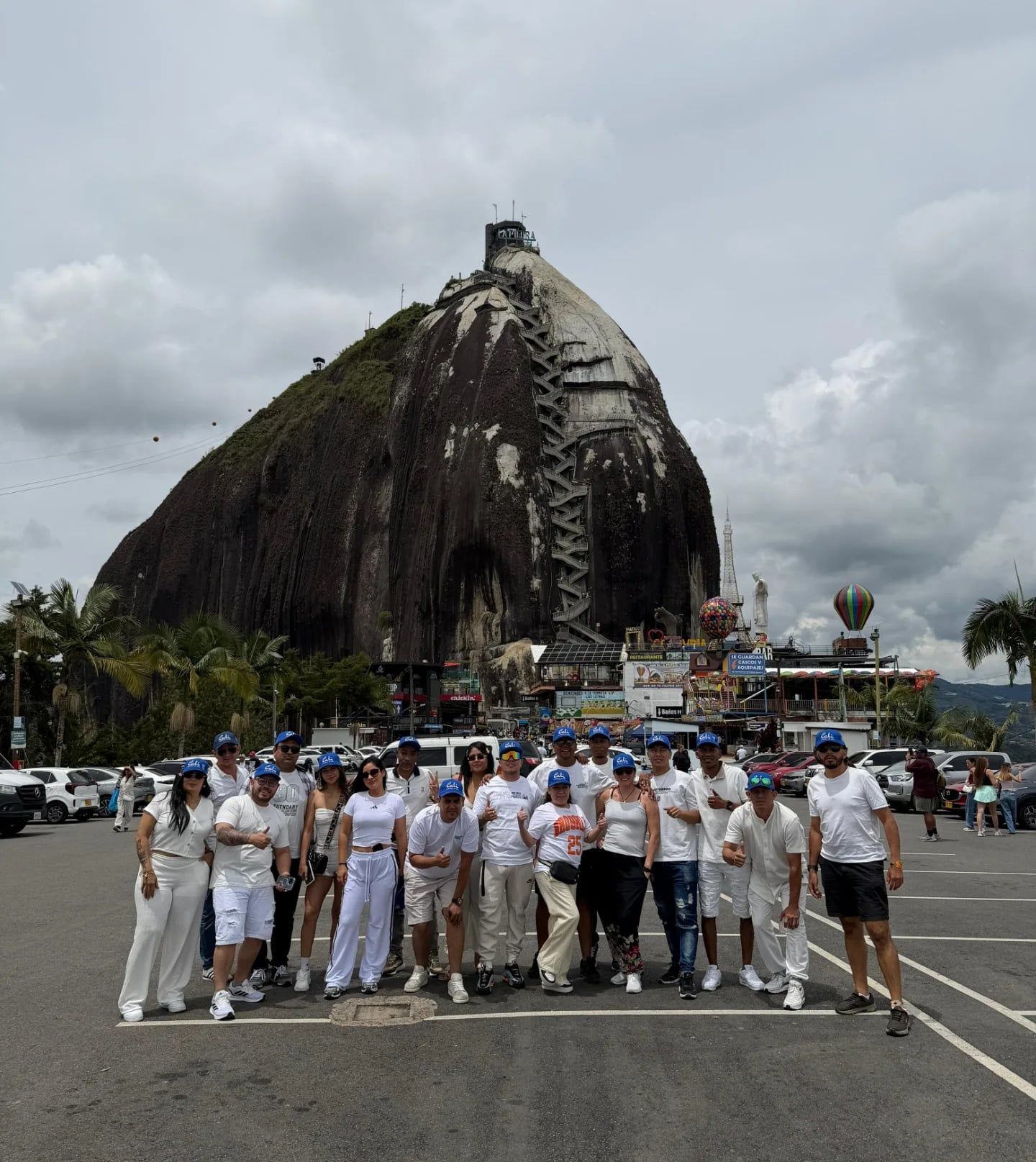
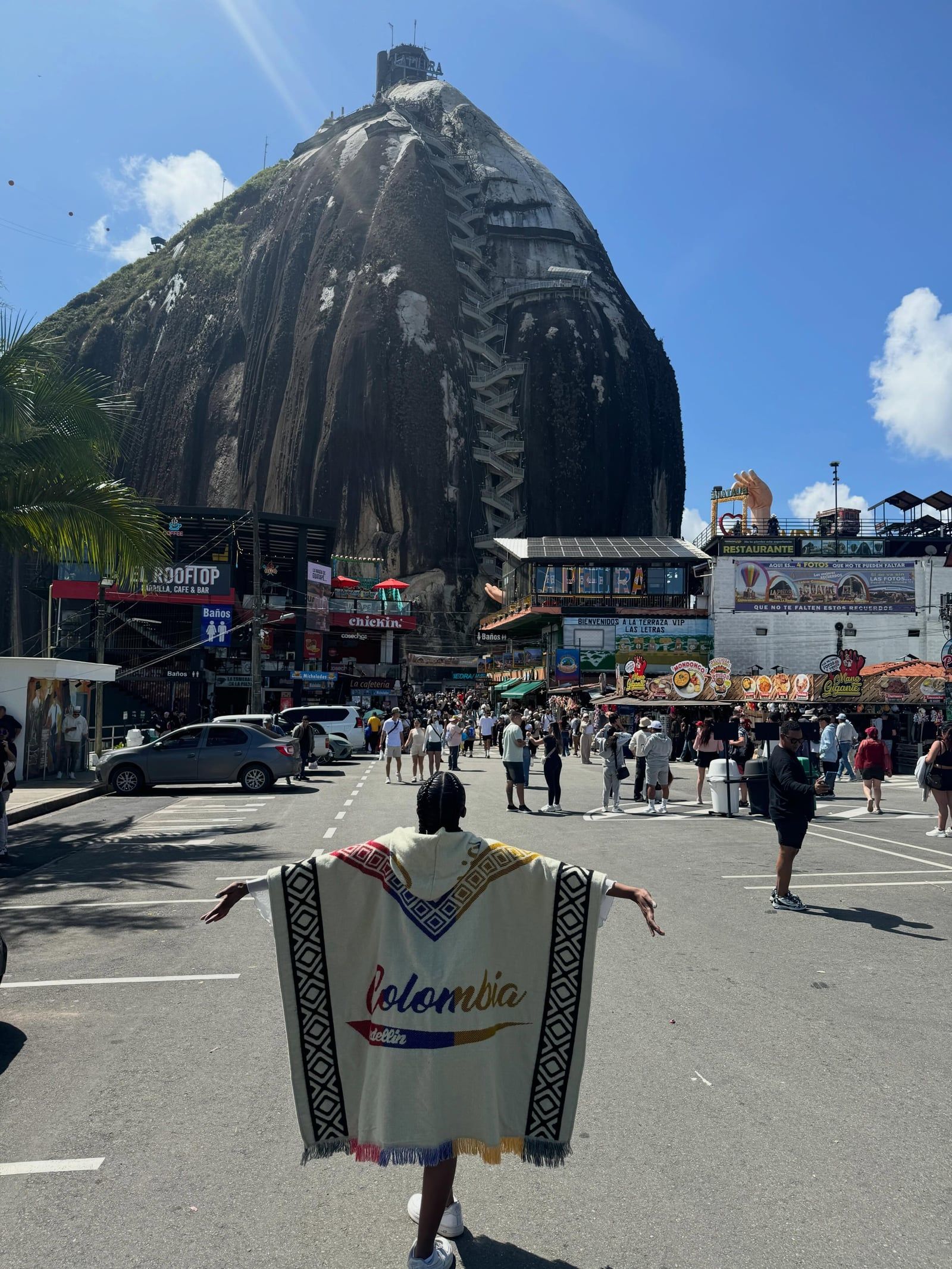
The standard on-site entrance fee is COP 20,000 to COP 25,000 (about USD 5) and must be paid in cash using Colombian Pesos. Advance reservations are not required, but you can purchase skip-the-line tickets online for COP 59,000 (USD 18).
The ascent up the 740 concrete steps typically takes 15 to 30 minutes depending on your physical fitness level. A complete visit usually lasts one to three hours, giving you enough time to rest, enjoy the 360-degree summit views, and explore the base shops.
The site is open daily from 8:00 AM to 6:00 PM, though some ticketing services close at 5:00 PM. To avoid massive crowds and tour buses, arrive right at 8:00 AM on a Tuesday, Wednesday, or Thursday.
You can take a bus from the Terminal de Transporte del Norte at counters 9 or 14, which takes about two hours and costs COP 15,000 to COP 21,000. Alternatively, an Uber ride covers the 80-kilometer distance in approximately 90 minutes for roughly USD 35.
Yes, the rock is located 4 kilometers from the Guatapé town square. You can hire a motorized tuk-tuk for COP 12,000 to COP 20,000, which takes 10 to 15 minutes to reach the pedestrian entrance.
Wear lightweight activewear and sturdy, closed-toe shoes with good grip to navigate the steep stairs safely. Bring a valid identification document, sun protection, and a reusable water bottle to stay hydrated during the 2,135-meter-high ascent.
The monolith is entirely unsuitable for wheelchair users or individuals with severely reduced mobility. There are no ramps, elevators, or cable cars available, making the 740-step staircase the only way to reach the summit.
The base ticket booth strictly requires cash payments in Colombian Pesos (COP) and does not accept credit cards or foreign currency. Visitors should withdraw enough cash in Medellín before departing, as the single ATM in nearby Guatapé frequently runs out of money.
Browse verified tours with free cancellation and instant confirmation.
Find Tours